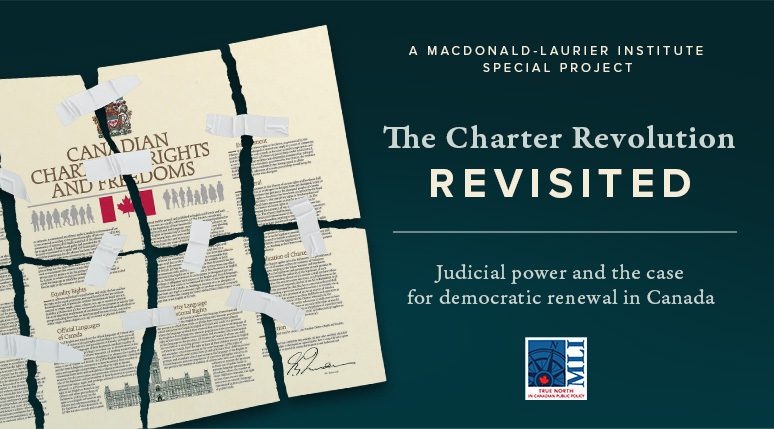
In July 2026, legal scholars from across the country met at the University of Calgary’s School of Public Policy to discuss Rainer Knopff and Ted Morton’s seminal book, The Charter Revolution and the Court Party, 25 years after its publication. The result of that conference is this series of eight essays compiled and published by the Macdonald-Laurier Institute. To listen to Knopff and Morton’s reflections at the conference click here.
Preface
Twenty-five years after Rainer Knopff and Ted Morton published The Charter Revolution and the Court Party, their account of how the Charter reshaped Canadian politics reads less like a period piece than a diagnosis of the present.
The book argued that the Charter did not merely empower courts in the abstract, but helped create a new legal-political ecosystem in which judges, lawyers, academics, advocacy groups, interveners, public funding programs, and sympathetic political actors used rights litigation and an expansive philosophy of judicial interpretation to move contested questions away from their rightful place in legislatures, into courtrooms.
In July 2026, legal scholars from across the country met at the University of Calgary’s School of Public Policy to discuss Knopff and Morton’s seminal book. This special project brings together the fireside chat with Knopff and Morton and a series of essays from a conference reflecting on the book’s legacy and contemporary relevance.
Contributors examine the rise of intervener groups and how they influence decisions, judicial selection and federalism, how so-called Charter values have expanded and now operate within the administrative state, the use of the notwithstanding clause, civil rights and Charter litigation, changing patterns in public support for the rule of law, and the broader question of how Canada can recover a healthier balance between courts, legislatures, and democratic self-government in the years ahead.
Contents
The Charter Revolution and the Court Party, 25 years on
By Peter Copeland and Geoffrey Sigalet
The Charter Counter Revolution and the Country Party
By F.L. (Ted) Morton and Rainer Knopff
The intervention industry: Empowering the judicial super-legislature
By Dave Snow
Why Canada’s Charter revolution requires changes to judicial selection
By Mark Harding
Responsibly invoking the notwithstanding clause
By Charlie Buck
The dynamics of public support for the rule of law
By Andrea Lawlor
Expanding reach: Charter values and administrative law
By Gerard J. Kennedy
The meaning of civil rights and Charter challenges: Seizing the constitutionalist banner
By Ryan Alford

