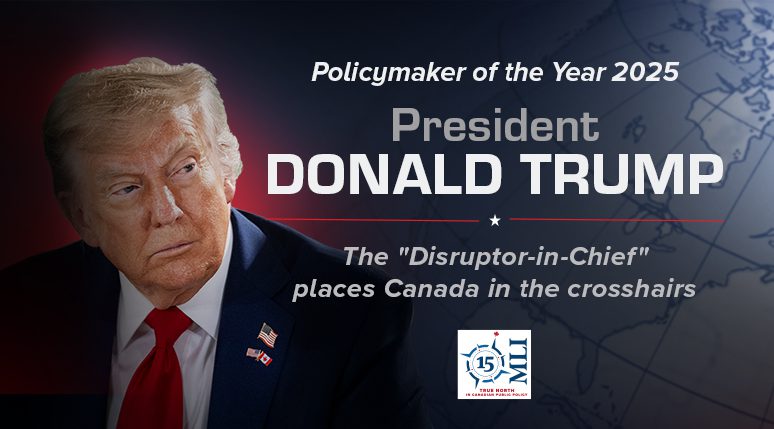
The “Disruptor-in-Chief” places Canada in the crosshairs
in Inside Policy, Latest News, Brian Lee Crowley, Casey Babb, Heather Exner-Pirot, Peter Copeland, Richard Shimooka, Tim Sargent
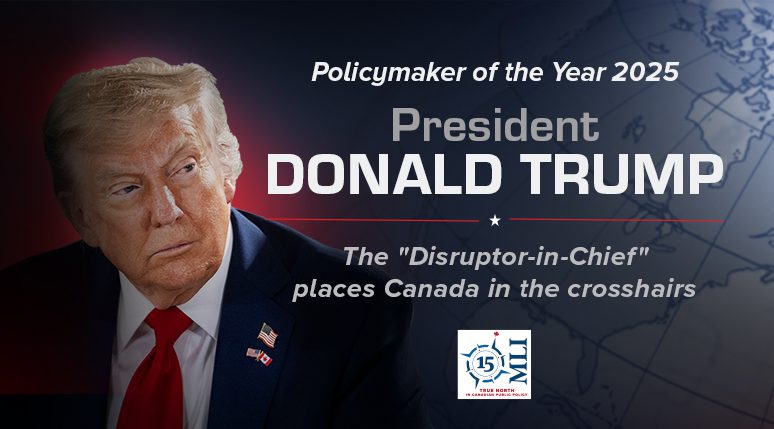
MLI has released its annual ‘policymaker of the year’. Donald Trump takes the title. Read the whole piece here, the intro, and my excerpts below.
December 19, 2025
Introduction
Brian Lee Crowley
Not for the first time, the Macdonald-Laurier Institute’s Policymaker of the Year is not a Canadian.
In 2019, our laureate was Xi Jinping, leader of the People’s Republic of China, whose long arm reached far into many aspects of policymaking in our nation’s capital.
That helps to underline our intention in conferring this recognition. Policy influence can be used to Canada’s benefit or detriment. In naming our annual Policymaker of the Year, MLI does not endorse their policies; instead, we seek to draw to the attention of Canadians those people who have had the most influence on public policy in this country – for good or ill – in the past year.
And in 2025, who can deny that US President Donald Trump, the Disruptor-in-Chief, has exercised an outsized influence on Canadians – on their hopes and fears, on their political preferences, and, most importantly for our purposes, on the policies pursued by the Canadian government?
How has Donald Trump spurred policy change in Canada? Let us count the ways:
First, set aside for the moment any focus on specific policy areas and just think about the President’s style and strategy. Anyone who has read The Art of the Deal knows that Trump is quite straightforward in avowing that his dealmaking strategy sets out to frighten and intimidate the other party with a degree of unpredictability, bravado, and unwillingness to be bound by past assumptions that is sometimes just breathtaking to contemplate.
On the other hand, what on the surface appears to his opponents as simply irrational is in fact nothing of the sort. He sets out to frighten and intimidate, but he also sets out to get deals done, which cannot happen with negotiating partners paralyzed by fear. And in fact, the list of deals he has done in less than a year in office is impressive: NATO members have made big commitments to increase defence spending, the war in Gaza is paused by a (shaky) ceasefire of his design, trade deals have been struck with many partners, including the EU, the UK, Mexico, and even China … though notably, not with Canada.
Here at home, Trump has riled Canadians with his comments about annexation and disputed borders, laid a heavy finger on the 2025 electoral scales, and met repeatedly with Prime Minister Mark Carney – but equally repeatedly sent him on his way with little to show for the Prime Minister’s efforts as supplicant. Policies that seemed settled, like our purchase of the F-35 fighter jet, our deep integration with the US economy, and our feeble attempts at even-handedness in the conflict in the Middle East, all seem to have fallen victim to Ottawa’s ill-advised urge to stick a finger in Donald Trump’s eye, whatever the cost.
Like it or not, Trump has reminded Canadians in no uncertain terms that America is the elephant and we are, if not exactly a mouse, certainly a beast whose wellbeing depends on American forbearance and good will. The question of whether we can calm the rampaging elephant and charm him into a better humour or fall back on much less profitable relations with other countries far away is THE question that will preoccupy policymakers in Ottawa this year and for several years to come.
It is against this backdrop that several major dimensions of Canada-US relations have been thrust into the spotlight – none more dramatically than trade.
Smashing the Overton Window on social policy
Peter Copeland
Donald Trump is polarizing for good reason. He is rude, crude, lewd, and norm-breaking to an extraordinary degree: a former Manhattan Democrat and social liberal whose transgressiveness and contempt for precedent embody many of the very cultural tendencies the left has long celebrated. His impulsiveness seems to threaten alliances and raise geopolitical risks by the day – yet he now leads the most effective conservative movement in decades.
He also possesses unusual strengths. His entrepreneurial instinct has allowed him to see the gap created by an oblivious, or unwilling, left- and right- establishment political class on trade, immigration, cultural and social decline – and to seize the opportunity. His unfiltered political style contrasts sharply with the scripted, risk-averse habits of career politicians and the professional-managerial class. He seeks no validation from the Davos set or the media-academic establishment, making him unafraid to challenge orthodoxy. Trump’s rise is a sharp indictment of liberal elites on both sides of the political spectrum, who proved incapable of addressing the deep social and economic issues that he foregrounded from the outset of his presidency.
On issues like gender identity, DEI, and mass migration, rooted in an extreme open-society ideology of hyper-individualism and autonomy, establishment leaders had long been unwilling even to acknowledge the problems. Then Trump came along and threw open the Overton window on just about every issue.
For Canada, Trump’s impact is mixed. He expanded the envelope of the politically possible on topics thought untouchable just years ago, but his abrasive style has made Canadian elites – whose defining characteristic is anti-Americanism – more reluctant to pursue parallel reforms. On immigration, borders and defence, Ottawa is now moving; on gender, DEI, and education, it is retreating behind “Trump did it, so we won’t.”
____________
Conclusion
Trump’s legacy remains unwritten. It may destabilize Western institutions, or it may be the jolt needed to shake a complacent boomer establishment out of its decadent, dogmatic slumbers.
Trump has clearly shifted the geopolitical landscape in both Canada and around the world – in ways no conventional figure could have. It is worth asking: would Europe have increased defence spending without American pressure? Would Canada have taken border security, immigration, defence, or energy policy seriously?
Even conservative governments – often differing little from liberal ones in practice – have lacked the capital or resolve to confront entrenched bureaucracies, and it remains doubtful whether any old-school Canadian libertarian-oriented fusionist, or a typical Wall Street Republican in the US, would have had what it took to win, yet alone enact the needed the reforms.
Trump was, and is, very much the man for the moment. Whether this shift leads to renewal or decline, only time will tell. Those same disruptive instincts have defined his approach to the world stage as well, reshaping geopolitics in ways Canadians cannot ignore.
Brian Lee Crowley is managing director of the Macdonald-Laurier Institute.
Tim Sargent is a senior fellow and the director of Domestic Policy at MLI.
Heather Exner-Pirot is a senior fellow and MLI’s director of Energy, Natural Resources, and the Environment.
Mark Reid is the senior editor at MLI.
Peter Copeland is the deputy director of Domestic Policy at MLI.
Richard Shimooka is a senior fellow at MLI.
Casey Babb is the director of MLI’s The Promised Land program.
 Peter Copeland