
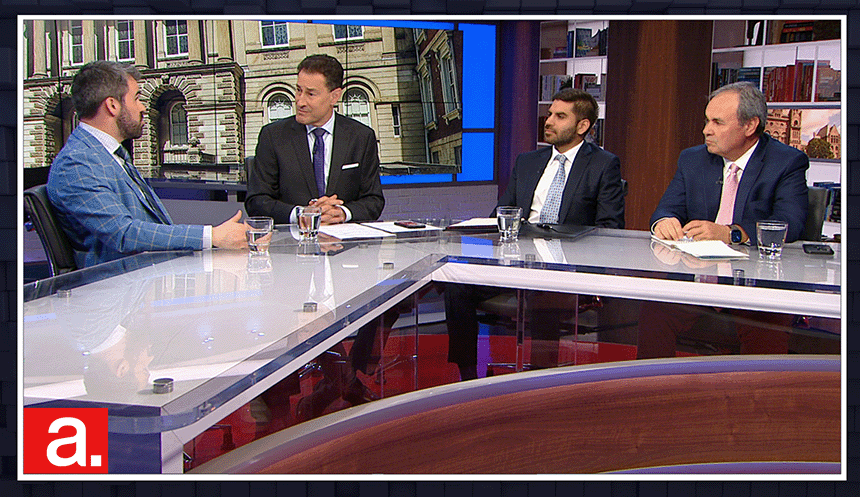
Video available here: https://bit.ly/44FIMAa
It was an honour to join Steve Paikin on TVO’s The Agenda, where we had a lively discussion on bail, judicial independence and appointments. Thanks to Shakir Rahim, Boris Bytensky, and Donna Kellway for a great discussion. I found much to agree with in their comments.
I focused on highlighting what I take to be a critical reality that’s seemingly overlooked: our judiciary is independent, merit-based, and inherently political—traits that are completely consistent and not at all incompatible. However, judicial decisions must not rely on loose or creative interpretations. Instead, they should be firmly grounded in the text and purpose of the law, respect our common law and natural law legal traditions, and demonstrate deference to Parliament, guided by a philosophy of judicial restraint.
Unfortunately, we have seen a trend of judicial activism undermining public safety and distorting the law.
Canadian courts have increasingly engaged in judicial activism, often using vague, expansive interpretations of the Charter of Rights and Freedoms. This approach has allowed the judiciary to transform the law in ways that go beyond the text and intent of the Charter, frequently undermining the role of Parliament and distorting legal principles. Here are a few key cases that illustrate this troubling trend:
Criminal Law and the “Reasonable Hypothetical Offender”
- R. v. Smith (1987) – The Supreme Court introduced the “reasonable hypothetical offender” standard, striking down a mandatory seven-year sentence for drug importation. Rather than assessing the law’s impact on the actual offender, the Court speculated about how it might apply to someone importing a negligible amount, such as a single marijuana joint. This method disconnected judicial review from the actual case before the court, allowing the invalidation of laws based on imagined scenarios. It isn’t even clear that based on a faithful interpretation of the text and legal tradition, one could invalidate the law in the hypothetical scenario.
- R. v. Nur (2015) – The Court invalidated mandatory minimum sentences for possessing a loaded prohibited firearm, reasoning that such a sentence could be disproportionately severe for hypothetical offenders—such as those inadvertently violating licensing requirements. This speculative approach allowed the Court to override a clear legislative choice aimed at addressing gun crime, and involves a clear value judgment on the part of the judges that is the clear purview of the legislature – not a matter of law.
- R. v. Lloyd (2016) – The Supreme Court struck down a one-year mandatory minimum for drug trafficking, using the “reasonable hypothetical” standard to imagine cases where the law might be overly harsh. The Court speculated about addicts sharing small quantities, bypassing the actual context of the case and creating a precedent for overturning laws without regard to their general application.
- R. v. Hills (2023) – A four-year mandatory minimum sentence for discharging a firearm into a residence was invalidated because the Court speculated that a less dangerous version of the offense (e.g., firing a paintball gun) could occur. This reliance on speculative scenarios again displaced legislative judgment with judicial imagination.
- R. v. Bissonnette (2022) – The Court struck down life sentences without the possibility of parole for multiple murders, arguing that such sentences violated human dignity and the right against cruel and unusual punishment. This man killed six people in a mosque shooting. This decision prioritized a speculative, rehabilitative approach even for the most serious offenders, disregarding public safety and the proportionality of punishment.
Cases Involving Expansive Interpretations of Rights
- R. v. Oakes (1986) – The Court established the “Oakes Test” for limiting Charter rights under Section 1. This extremely flexible, multi-step test has enabled judges to assess government actions based on subjective criteria, creating inconsistency in the application of Charter rights.
- The test consists of two main parts and within the second part, there are three sub-factors, making a total of four factors that courts must consider.
- The problem with the test is that the concepts are vague and abstract. For example, what counts as ‘pressing and substantial’ is not easy to understand, and has not been defined, leaving courts with broad latitude. How do judges determine whether a law ‘minimally impairs’ a right? It often ends up depending on policy preference and value judgments rather than clear legal standards. Lastly, proportionality is highly subjective – weighing the harms and benefits of law involves philosophical and politcial considerations, not just legal reasoning.
- The result has been that judges may inject their own ideological views into rulings under the guise of constitutional interpretation; courts can override democratic decisions by striking down laws they subjectively deem unjustified; and the test often favours state power when judges defer to government arguments about security, public order, or social policy.
- R. v. Morgentaler (1988) – The Supreme Court effectively created a constitutional right to abortion under Section 7, despite no explicit mention of such a right in the Charter. This decision stretched the right to “security of the person” beyond its text and context, effectively making policy decisions meant for Parliament. In this case, the court prioritized ‘security of the person’ over life itself – something technically possible under the charter.
- Canada (Attorney General) v. Bedford (2013) – The Court struck down prostitution laws, citing potential risks to prostitutes. This decision replaced Parliament’s attempt at a balanced approach with a judicially imposed vision, assuming that it could better assess the social impact of the law – something that is the proper purview of the legislature.
- Carter v. Canada (2015) – Overturning its own precedent in Rodriguez (1993), the Court established a right to assisted suicide and euthanasia. This marked a significant expansion of Section 7 without any change to the text of the Charter, reflecting judicial policy-making rather than interpretation.
- The Regional Municipality of Waterloo v. Persons Unknown (2023) – The Ontario Court of Justice invalidated a bylaw prohibiting homeless encampments, ruling that it violated Section 7 (right to life, liberty, and security of the person). The Court expanded the concept of “security of the person” to include a right to occupy public property, undermining local authority.
- UR Pride v. Saskatchewan (2023) – The Saskatchewan Court of King’s Bench blocked a policy requiring parental consent for schools to recognize name and gender pronoun changes for students under 16. The decision dismissed parental rights, relying on an expansive interpretation of harm without textual support in the Charter.
- Harm Reduction Nurses Association v. British Columbia (2023) – The British Columbia Supreme Court halted enforcement of a law prohibiting drug use in public spaces, arguing it violated Section 7. This speculative interpretation prioritized perceived individual rights over public safety and community welfare.
- Fair Change v. His Majesty the King in Right of Ontario (2024) – The Court struck down restrictions on panhandling under the Safe Streets Act, expanding the concept of freedom of expression to include aggressive begging. This transformed a public safety measure into a constitutional issue, weakening the government’s ability to protect public spaces.
- Ontario (Health Insurance Plan) v. K.S. (2024) – The Ontario Divisional Court required public funding for a specific ‘gender-affirming’ surgery based on vague “Charter values” rather than Charter rights. The case involves a male who identifies as ‘non-binary’ – a scientifically nonsensical concept – and demands that taxpayers pay for plastic surgery to ‘construct a vagina’ for him while preserving his penis intact. This decision exemplifies judicial creativity, creating an entitlement without a textual basis.
- Chaoulli v. Quebec (Attorney General) (2005) – The Court struck down Quebec’s prohibition on private healthcare, relying on a broad interpretation of Section 7. This effectively imposed a specific health policy on the province, undermining provincial jurisdiction and legislative authority.
- Vriend v. Alberta (1998) – The Supreme Court read “sexual orientation” into Alberta’s human rights legislation, despite the term’s absence from the statute. This was a clear case of “reading in” language, expanding legislative text through judicial interpretation.
- Egan v. Canada (1995) – The Court recognized sexual orientation as an analogous ground under Section 15, despite it not being listed. This decision extended equality rights beyond the text of the Charter, setting a precedent for ongoing judicial expansion of rights.
Further evidence of the judicialization of politics in Canada is found in this Macdonald-Laurier Institute report on the Court Challenges Program by Professors Dave Snow and Ryan Alford. They clearly show that the Court challenges program (CCP) is a vehicle for governments that are so inclined to fund litigation that seeks to undermine the government’s own legislation, rather than the government attempting to legislate the reforms themselves. The report uses data from the CCP’s annual reports to show that the program’s “human rights” panel has an overwhelming left-wing bias, with 96 per cent of the CCP’s “example cases” funding left-wing activism.
Legal and Public safety reforms
Legal and public safety reforms could include:
- Clarify Section 7’s “Principles of Fundamental Justice.”
- Prioritize Fundamental Freedoms (Section 2) over other rights, and ensure there is a clear hierarchy of rights.
- Establish a clearer, more consistent test for “reasonable limits” under Section 1.
- Respect the Notwithstanding Clause (Section 33) to protect democratic decisions.
- Move away from a living-tree, freewheeling style of interpretation; establish clearly defined and narrow judicial tests, and hew to judicial interpretation that is text-based and rooted in our common law and natural law legal traditions.
- Introduce targeted mandatory minimums for serious crimes, with limited exceptions to preserve judicial discretion.
- Implement structured sentencing guidelines to ensure consistency.
- Strengthen post-sentencing supervision for high-risk offenders.
Justice must protect public safety, uphold democratic accountability, and respect the text and purpose of our laws. Judicial activism undermines these principles. It’s time for a more balanced, principled approach to justice in Canada.
 Peter Copeland